
Natural Gas Transmission
FGSZ Natural Gas Transmission Ltd. (hereinafter FGSZ) is the sole transmission system operator and a 100% subsidiary of MOL. It owns and operates the nearly 6,000 km long high-pressure natural gas transmission pipeline system covering the territory of Hungary, supplying gas distribution companies, power plants and a number of large industrial consumers. FGSZ performs its activities under regulated market conditions and, in compliance with EU rules, has been ITO-certified since 2012.
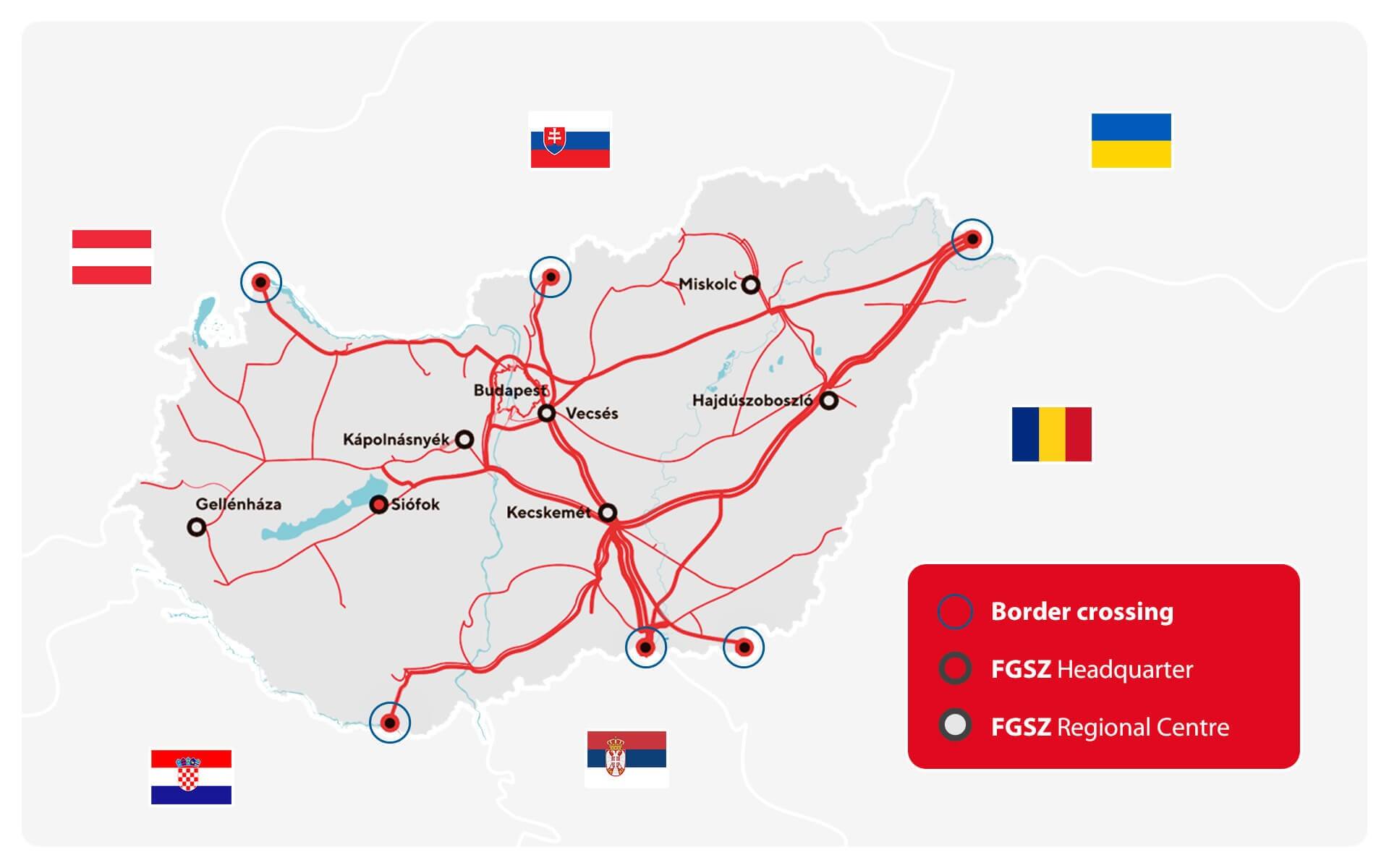
Following the construction of the first natural gas pipeline in Hungary in 1938, the gas transmission network has developed organically and FGSZ, as a strategically important company in the region, has been transporting gas internationally for some time by now, besides its domestic activities. The Company has been operating interconnectors with six neighbouring countries: bidirectional points with Slovakia, Ukraine, Romania, Serbia and Croatia, and an entry point from Austria. In international comparison, the Company’s grid is operated according to the highest technological standards.
HIGHLIGHTS
- 5,889 km long high-pressure pipeline system
- 28 entry points, nearly 400 gas delivery stations
- 3 operational regions with 2-2 sites, 8 compressor stations
- 6 interconnection points
- High technical class control center in Siófok
- ~700 employee
- Transmission volumes (2025): 17,1 bcm
ACTIVITY
FGSZ is the sole transmission system operator of Hungary. It performs its activity under market conditions regulated by law, according to the ITO certificate. The Company’s main activity is the construction, operation, and allocation of natural gas transmission capacity, of which it offers yearly, quarterly, monthly, daily, and within day firm and interruptible capacities through auctions. The Company’s main responsibilities include the odorization and continuous quality control of natural gas delivered to partners for safety purposes, the maintenance of the hydraulic balance of the transmission system, as well as the measurement of quantitative and qualitative characteristics of natural gas in a transparent manner, in compliance with the most stringent international standards.
FGSZ plays an important role in delivering gas production to consumers in Hungary and, to meet the needs of domestic network users from imported supplies, it also carries out international gas transportation activities besides domestic gas transmission. It operates bidirectional interconnection points with Slovakia, Ukraine, Romania, Croatia, and Serbia, as well as a unidirectional entry point from Austria. The security of supply of Hungary is inseparable from the energy security of the CEE region and the whole of Europe. Therefore, within the framework of the European gas market cooperation based on mutual advantages, FGSZ aims to ensure the interoperability of the natural gas networks of the region from Hungary, and also strives to increase the transit volumes through Hungary.
To maintain and increase the operational safety of the natural gas transmission system, the Company applies the Pipeline Infrastructure Management System (PIMS) as part of its integrated management system and continuously improves the conditions necessary for safe operation.
DEVELOPMEN PROJECTS AND INITIATIVES
PIPELINE DEVELOPMENTS
FGSZ, as a reliable and efficient operator of the Hungarian natural gas transmission system, intends to enhance flexibility and security of supply on the regional natural gas market. Developments aim at establishing new routes and strengthening existing interconnections providing opportunities for network users to access new sources and exploit trading possibilities. FGSZ is also continuously implementing improvements to enhance efficient utilization of the existing network, while FGSZ being actively involved in regional initiatives as well, such as the Vertical Corridor.
The primary objective of FGSZ's developments is to ensure the possibility to transport natural gas to Hungary from all potential directions, as well as to implement internal network improvements that will help to adapt to the changes in the international transport environment. By expanding its existing capacities, the company aims to become a key playerof the regional gas transmission network.
To enhance the capacity of cross-border interconnection points, FGSZ has implemented several projects, and further developments are also underway. The technical capacity of the RO–HU interconnection point increased to 2.8 billion cubic meters per year as of April 2026. Expanding this capacity to as much as 4.4 billion cubic meters per year could significantly support Hungary’s source diversification efforts, as in the medium term gas from Romanian Black Sea sources, as well as Azerbaijani and Mediterranean gas, and supplies arriving at Greek or Turkish LNG terminals could also be delivered via this route. At the Balassagyarmat interconnection point, in the HU>SK direction, the technical capacity increased to 4.38 billion cubic meters per year as of December 2025. Currently, the project required to ensure capacities in the HU>UA direction is under implementation, through which a capacity level of 3.5 billion cubic meters per year will be made available.
Slovenia is Hungary’s only neighboring country without a direct natural gas interconnector to Hungary. To establish a new HU–SI gas transmission pipeline connection, FGSZ and its Slovenian partner, Plinovodi, signed a joint declaration of intent in March 2026.
REGIONAL BOOKING PLATFORM
The Regional Booking Platform (RBP) of FGSZ is an IT application developed in accordance with the EU network code governing the capacity allocation mechanisms used in natural gas transmission networks and with other relevant EU and national legislation. The capacity allocation application enables capacity allocation procedures and secondary capacity trading among other services. Today – beyond FGSZ – sixteen other transmission system and storage operators use it partially or entirely throughout the EU and the Energy Community. The applications are continuously being developed in line with regulatory and business needs.
LINEPACK FLEXIBILITY SERVICE
FGSZ launched the Linepack Flexibility Service (LPFS) in December 2022 owing to which network users could significantly reduce their costs related to balancing.
SUSTAINABILITY
In line with decarbonisation efforts, FGSZ places strong emphasis on sustainability and tasks related to the green transition. The company is exploring ways to adapt its existing transmission system to changing demands and to the transport of renewable gases (biomethane and hydrogen), as well as the conditions for their injection into the network. To better understand market needs, in 2025 FGSZ conducted its latest non-binding market demand assessment for future hydrogen transportation, covering domestic entry and exit points as well as potential future cross-border interconnection points. The result indicated significant hydrogen demand by 2030 on both the production and consumption sides, accompanied by both export and import needs.
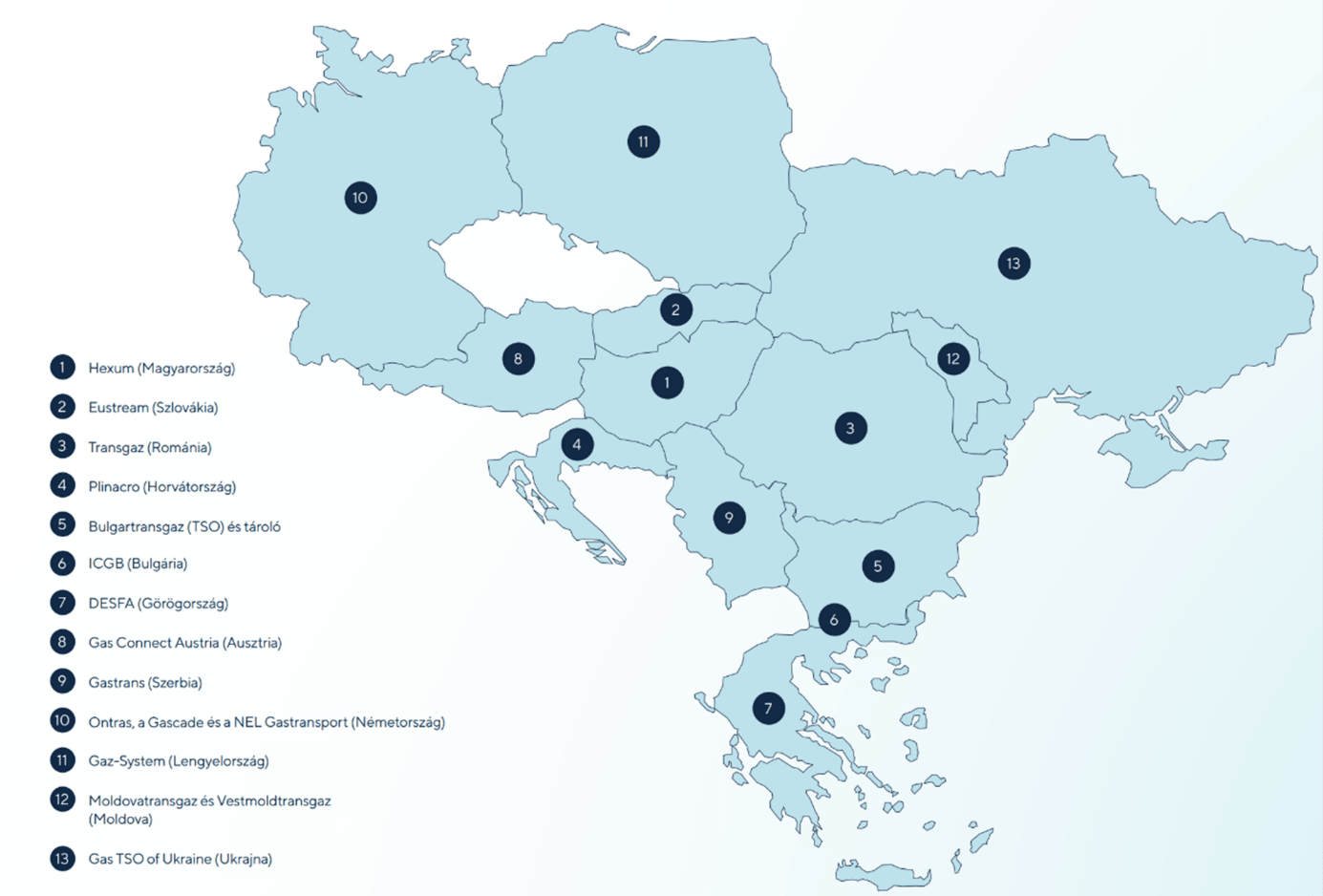
FGSZ is a member of the SEEHyC (South-East European Hydrogen Corridor) initiative, which brings together eight high-pressure transmission system operators from seven countries with the aim of creating a hydrogen transmission backbone network extending from Greece to Germany. A section of the corridor in Hungary has been included in the European Commission’s list of Projects of Common Interest (PCI), making the project eligible to apply for funding under the Connecting Europe Facility (CEF).
Within its other projects, the Company aims to make its current operations more sustainable. To reduce greenhouse gas emissions, by 2025 FGSZ has already implemented methane leak detection and repair (LDAR) activities across its entire area of operation, using advanced leak detection and concentration measurement equipment. To reduce the energy intensity of its operations, FGSZ has also implemented a number of energy efficiency improvements. The Company is a voluntary member of the Oil and Gas Methane Partnership (OGMP), under which it quantifies and reduces its methane emissions in line with the organization’s guidelines and through a structured implementation program. In 2025, FGSZ received the OGMP 2.0 Gold Standard certification for the second time.